Posts

Showing posts with the label Flow Measurement

Multivariable Pressure Transmitter or DP Transmitter?

Image
Know Your Flow Experts answering your Process Questions   The Question: Should I use a Multivariable Pressure Transmitter or DP-only Transmitter for Air Flow Measurement? The Expert: James Seagraves Senior Sales Engineer, Eastern Instruments - Over 30 years of experience in Air Flow and Solids Flow Measurement This is a question I receive all the time, as both types of transmitters measure the differential pressure (DP) of the air flow in a duct. To provide the best answer, let's first review the fundamentals of air flow measurement. Basics of Air Flow Measurement A Typical Pitot Tube in an Air Stream Typical Pitot Tube in an air stream One of the most reliable and time-tested methods of measuring the air flow in a duct is to use a differential pressure device like a pitot tube.  The pitot tube is inserted into the air stream to measure the pressure differential created between the High port and Low port on the pitot, also known as the Dynamic or Velocity Pressure. High Port (...
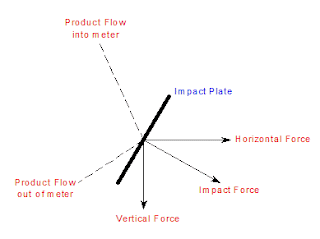
Differences between the Impact Flow Meter and the Centripetal Force Flow Meter

Image
There are a lot of solids flow meters on the market these days.  But not all of these devices are the same, even though they may look the same.  Many companies promote their devices as one thing, but underneath the hood they are really something else.  So, how does a plant manager, process engineer, or maintenance manager tell the difference to pick the device they need to get the results they need?  This blog will try to help clarify the difference between two of the most popular solids flow meters, the impact meter or impact flow meter and the centripetal force meter. HOW THEY WORK The Impact Flow Meter: The impact flow meter goes by many different names like impact meter, impact scale, impact weigher or impact flow meter, but they are all basically the same.  The measurement technique for an impact meter is fairly simple, product flow is dropped down a chute and directed to impact plate at a specific angle and flow rate. The impact creates an imp...

Measuring Mass Flow of Air in a Duct with a Multivariable Transmitter

Image
When measuring the mass flow of air flow in a duct or pipe, using the correct flow element is half the battle .  After deciding that using a differential pressure device like a Velocity Averaging Pitot is the right way to go, getting the correct instrumentation to measure that differential pressure is not something that every transmitter can do. VAP³ Velocity Averaging Pitot In typical industrial, combustion, and power generation applications , the differential pressure to be measured ranges from a high of 8 to 10 inches of water column down to 0.25 inch of water column or even less.  Getting a transmitter that can measure these ranges and have a turndown that can measure the low end accurately usually requires getting a laboratory type of transmitter, rather than an industrial differential pressure transmitter.  These are typically not satisfactory for these types of applications, so most users go with an industrial transmitter that has a very large URL (upper ran...

Air Flow Measurement Accuracy within a Particulate Laden Air Stream

Image
Measuring the Air Flow in a duct can be difficult enough when the flow profile is not free from turbulence, disturbances, cyclonic flow, and reverse flow, but add to that particulate, ash, dust, or debris in the air, and it can almost be impossible.  So, how do you get accuracy when trying to measure the Air Flow in a duct that has particulate, ash, dust, or debris in the air stream? The traditional way is to use a blast purge or blow back system that will take high pressure compressed air and blow it back through the high and low ports of the air flow pitot or flow element so that any particles, ash, dust, or debris is blown out of the ports on the probe.  This not only uses a lot of compressed air, which needs to be completely dry to work properly, but it also requires a complex system of valves in order for this to be done automatically.  If the blast purge or blow back is not done on a regular basis, and if the particulate, ash, dust, or debris level is high enough ...

Measuring the Mass Flow of Difficult to Handle Powders with the CentriFlow Meter

Image
Measuring the mass flow rate and totalization of a dry solid material can be difficult when that product is a hard to handle powder.  Product characteristics like particle size, cohesiveness, flowability, bulk density can all affect the accuracy of the mass flow measurement of a powder.  Below we will look at these characteristics in more detail and discuss how the CentriFlow Solid Mass Flow Meter is suited to deal with issues from these characteristics, making them non-issues or helping to eliminated/overcome them to get the best accuracy possible. CentriFlow Meter - Type II Configuration Particle Size: Particle size can become an issue when a material's particles get down to the powder regime, around 0.0394" or 1000 microns (18 mesh) and smaller.  The smaller the particle, usually the more trouble it can be to handle and therefore to measure.  However, there are definitely small particles that are not an issue, like sand, which can fall into the 0.0098" or ...