Posts

Showing posts with the label Dry Powder Material

Choosing a Solids Flow Meter - When is testing is needed?
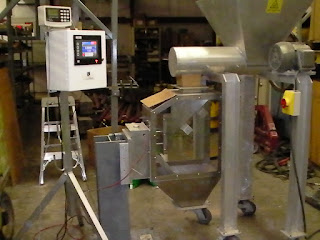
Image
Not all Solids Mass Flow Meters are created equally, so how do you know which meter is best suited to measure your product??? When asking this question, the best answer is, when in doubt, test some product!  Most manufacturers of mass flow meters should have a test lab and a list of products that they have tested with their devices, building a database of what works and what does not work. WHAT TO LOOK FOR WHEN EXPLORING THE TESTING OPTION? REPLICATE THE INSTALLATION - Testing a product sample should also be done in a way that replicates the application or installation location.  This means that the equipment being used for testing should be similar to that of what will be used in the field.  For example, if the application calls for a flow meter (flowmeter) to be installed under the discharge of a screw conveyor, then the testing lab should have a screw conveyor. Simulation of Screw Conveyor Feeding a CentriFlow Type II Meter Simulation of Belt Fee...

Measuring the Mass Flow of Difficult to Handle Powders with the CentriFlow Meter

Image
Measuring the mass flow rate and totalization of a dry solid material can be difficult when that product is a hard to handle powder.  Product characteristics like particle size, cohesiveness, flowability, bulk density can all affect the accuracy of the mass flow measurement of a powder.  Below we will look at these characteristics in more detail and discuss how the CentriFlow Solid Mass Flow Meter is suited to deal with issues from these characteristics, making them non-issues or helping to eliminated/overcome them to get the best accuracy possible. CentriFlow Meter - Type II Configuration Particle Size: Particle size can become an issue when a material's particles get down to the powder regime, around 0.0394" or 1000 microns (18 mesh) and smaller.  The smaller the particle, usually the more trouble it can be to handle and therefore to measure.  However, there are definitely small particles that are not an issue, like sand, which can fall into the 0.0098" or ...